Only iron and steel rust. Other metals corrode. Rusting is an oxidation
process. What we normally call rust is a flaky red-brown solid which is largely
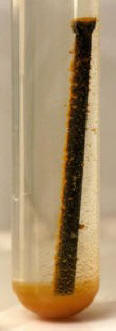
hydrated iron.The primary corrosion product of iron is Fe(OH)2 (or more likely FeO.nH2O),
but the action of oxygen and water can yield other products having different colors:
-
Fe2O3.H2O
(hydrous ferrous oxide, sometimes written as Fe(OH)3) is the principal
component of red-brown rust. It can form a mineral called
hematite.
-
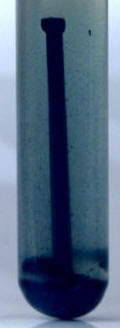
Fe3O4.H2O
("hydrated magnetite" or ferrous ferrite, Fe2O3.FeO) is
most often green but can be deep blue in the presence of organic complexants
as shown here.
-
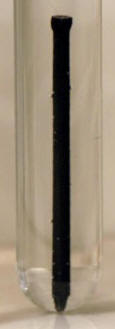
Fe3O4
("magnetite") is black
| Red-brown flaky rust |
Black magnetite |
Blue/green unstable rust |
 |
 |
 |
So, you are wondering, how did we make these experiments.
-
For the first experiment
we put a 5 cm finishing nail brushed with steel wool in a test tube containing
8 mL of tap water. The picture was taken three days later.
-
The second experiment
was carried out with an acidic solution containing 12% acetic acid. The
second picture was taken an hour after the start of the experiment. You
can produce a similar reaction with vinegar which typically contains 3%
acetic acid in water. However, you will have to be more patient than we
were.
-
In the third experiment
a pellet of sodium hydroxide (caustic 'Drano') was dropped in the test tube
of the second experiment. The test tube was capped to prevent air to react
with the solution. After three hours blue rust precipitates had more or
less settled out as you can see in this picture.
If you have some questions please send them to our
...and do not be surprised if we post your questions right here.
|
Formula
|
Color
|
Oxidation State
|
Structure / comments
|
|
Fe2O3.H2O or Fe(OH)3
|
red brown
|
Fe3+
|
a-form
Hematite, b-form used
in recording tapes
|
|
Fe3O4
|
black
|
Fe2+/3+
|
magnetite/lodestone
|
| Fe(OH)2 |
blue/green |
Fe2+
|
soluble, the color going from yellow to green and
blue by changing the pH of the solution from acidic to very basic
|
|
FeO
|
black
|
Fe2+
|
pyrophoric
|
See also:Equilibrium
reactions of iron in water,
Iron corrosion products,
Iron species and their thermodynamic data,
Pourbaix diagram of iron,
Rust chemistry,
Rust converters,
Steel corrosion

Hematite has several varieties, each with their
own unique names. (reference)
- Hematite Rose is a circular arrangement of bladed crystals giving
the appearance of the flower of a rose.
- Tiger Iron is a sedimentary deposit of approximately 2.2 billion
years old that consists of alternating layers of silver gray hematite and red
jasper, chert or even tiger eye quartz.
- Kidney Ore is the massive botryoidal form and gives the appearance
of lumpy kidney-like masses.
- Oolitic Hematite is a sedimentary formation that has a reddish brown
color and an earthy luster and is composed of small rounded grains.
- Specularite is a micaceous or flaky stone that is sparkling silver
gray and sometimes used as an ornamental stone.
Hematite is an important ore of iron and it's blood red color (in the powdered form)
lends itself well in use as a pigment. Hematite gets its name from a greek word
meaning blood-like because of the color of its powder. Ancient superstition held
that large deposits of hematite formed from battles that were fought and the subsequent
blood that flowed into the ground. Crystals of Hematite are considered rare and
are sought after by collectors as are fine Kidney Ore specimens.
PHYSICAL CHARACTERISTICS:
- Color is steel or silver gray to black in some forms and red to brown
in earthy forms. Sometimes tarnished with irredescent colors when in a hydrated
form (called Turgite).
- Luster is metallic or dull in earthy and oolitic forms.
- Transparency: Crystals are opaque.
- Crystal System is trigonal; bar 3 2/m
- Crystal Habits include tabular crystals of varying thickness sometimes
twinned, micaceous (specular), botryoidal and massive. also earthy or oolitic.
- Cleavage is absent however there is a parting on two planes.
- Fracture is uneven.
- Hardness is 5 - 6
- Specific Gravity is 5.3 (slightly above average for metallic minerals)
- Streak is blood red to brownish red for earthy forms.
- Associated Minerals include jasper (a variety of quartz) in
banded iron formations (BIF or Tiger Iron), dipyramidal quartz, rutile,
and pyrite among others.
- Notable Occurrences especially nice specimens come from England,
Mexico, Brazil, Australia and the Lake Superior region.
- Best Field Indicators are crystal habit, streak and hardness.
The Hematite Group is a more or less informal group of closely related
trigonal oxides. Their relationship is linked through their similar structures.
The general formula for this group is A
2O3. The
A cations can be either iron, titanium, aluminum,
chromium, vanadium, magnesium, antimony, sodium, zinc and/or manganese. (reference)
The structure is composed of alternating layers of cations and oxygens. The cations
occupy spaces in layers between the oxygen layers and each are bonded to three oxygens
in the above layer and three oxygens in the bottom layer. Not all of the sites for
these cations are occupied as only two out of three are filled. If all the sites
were filled then the formula would be AO in
stead of A 2O3.
In the Ilmenite Subgroup, alternating layers of cations are occupied by only
titanium or antimony and the other cation layers are occupied by a dissimilar cation.
This lowers the symmetry of this subgroup (bar 3); from the other members of this
group (bar 3 2/m). The other members are not similarly affected because their
A cations are all the same and thus there is no
asymmetry to their stacking sequence. The same symmetry phenomena occurs between
the Calcite Group and the Dolomite Group of carbonates.
These are the members of the Hematite Group:
- Corundum (Aluminum Oxide)
- Eskolaite (Chromium Oxide)
- Hematite (Iron Oxide)
- The Ilmenite Subgroup
- Brizziite (Sodium Antimony Oxide)
- Ecandrewsite (Zinc Iron Manganese Titanium Oxide)
- Geikielite (Magnesium Titanium Oxide)
- Ilmenite (Iron Titanium Oxide)
- Melanostibite (Manganese Antimony Oxide)
- Pyrophanite (Manganese Titanium Oxide)
- Karelianite (Vanadium Oxide)