|
 |
 |
|
|
| Hindenburg Cover-upThe perceived dangers of hydrogen are irretrievably linked in the public mind with the tragic fate of the Hindenburg airship, which burst into flames in May 1937, killing 36 of the 97 people on board. Common lore attributes the disaster to the inherent flammability of the gas. (reference)
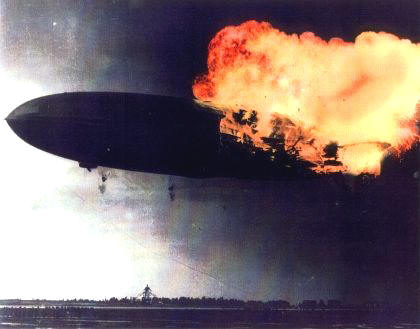
The LZ 129 fire in its early phase. Historical B&W photo colored from eye witnesses' testimonies by Addison Bain, NASA's rocket fuel specialist (photo courtesy reference 42). Bain's hunt for the truth about the Hindenburg began in the late 1960s, when he was working on hydrogen systems. The Hindenburg was frequently used as an example in hydrogen safety manuals, but the reported observations of the incident were inconsistent. For example, Bain noticed that the fire burned rapidly in many directions, the zeppelin remained aloft and upright for many seconds after the initial flames were seen, and the flames were bright - none of which are consistent with a hydrogen explosion. His extensive research of the original documentation of the disaster was what convinced him that the airship's materials had contributed to the ignition of the blaze, but he lacked solid evidence to prove his theory. Finally, in 1994 Bain obtained samples of the fabric that had covered the Hindenburg and had a volunteer team of scientists analyze them using a variety of physical and chemical techniques, including an infrared spectrograph and a scanning electron microscope, which provided the chemical signatures of the organic compounds and elements present. His conclusion
|