Module Six of CCE 281 Corrosion: Impact, Principles, and Practical Solutions
|
|
Corrosion Fatigue |
|



Corrosion-fatigue is the result of the combined action of an alternating or cycling stresses and a corrosive environment. The fatigue process is thought to cause rupture of the protective passive film, upon which corrosion is accelerated.If the metal is simultaneously exposed to a corrosive environment, the failure can take place at even lower loads and after shorter time.
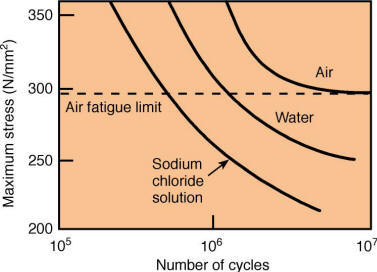 |
In a corrosive environment the stress level at which it could be assumed
a material has infinite life is lowered or removed completely. Contrary
to a pure mechanical fatigue, there is no fatigue limit load in corrosion-assisted
fatigue.
Corrosion fatigue and fretting are both in this class. Much lower failure stresses and much shorter failure times can occur in a corrosive environment compared to the situation where the alternating stress is in a non-corrosive environment.(reference) |
| The fatigue fracture is brittle and the cracks are most often transgranular, as in stress-corrosion cracking, but not branched. The picture shown here reveals a primary corrosion-fatigue crack that in part has been widened by a secondary corrosion reaction. The corrosive environment can cause a faster crack growth and/or crack growth at a lower tension level than in dry air. Even relatively mild corrosive atmospheres can reduce the fatigue strength of aluminum structures considerably, down to 75 to 25% of the fatigue strength in dry air. (photo courtesy) |
 |
No metal is immune from some reduction of its resistance to cyclic stressing if the metal is in a corrosive environment. Control of corrosion fatigue can be accomplished by either lowering the cyclic stresses or by various corrosion control measures (see checklist).
| (previous) | Page 22 of 23 | (next) |
- Corrosion incidents of aircraft and helicopters
- Structural integrity
- Pitting corrosion incidents
- PCF models
- Validity of PCF models
Protection Possibilities Checklist
- Minimize or eliminate cyclic stresses
- Reduce stress concentration or redistribute stress (balance strength and stress throughout the component)
- Select the correct shape of critical sections
- Provide against rapid changes of loading, temperature or pressure
- Avoid internal stress
- Avoid fluttering and vibration-producing or vibration-transmitting design
- Increase natural frequency for reduction of resonance corrosion fatigue
- Limit corrosion factor in the corrosion-fatigue process (more resistant material / less corrosive environment).