Sulfuric Acid
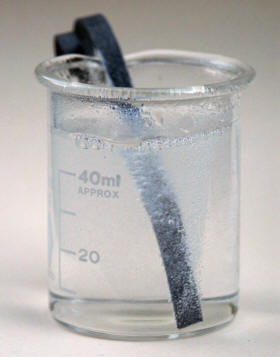
Sulfuric acid reacts with most metals to dissolve them producing hydrogen. In the picture the strip of zinc reacts violently with the acid according to the following equation:
Zn(s) + H2SO4(aq) → H2(g) + ZnSO4(aq)
Although sulfuric acid is now one of the most widely used chemicals, it was probably little known before the 16th century. It was prepared by Johann Van Helmont (c.1600) by destructive distillation of green vitriol (ferrous sulfate) and by burning sulfur. The first major industrial demand for sulfuric acid was the Leblanc process for making sodium carbonate (developed c.1790). Sulfuric acid was produced at Nordhausen from green vitriol but was expensive. A process for its synthesis by burning sulfur with saltpeter (potassium nitrate) was first used by Johann Glauber in the 17th century and developed commercially by Joshua Ward in England c.1740. It was soon superseded by the lead chamber process, invented by John Roebuck in 1746 and since improved by many others. The contact process was originally developed c.1830 by Peregrine Phillips in England; it was little used until a need for concentrated acid arose, particularly for the manufacture of synthetic organic dyes. (reference)
(back)
Connect with us
Contact us today