Nikola Tesla (1856-1943)
Part 1 - The Early Years
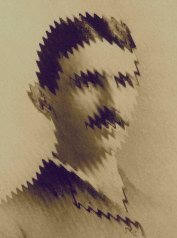 From the time he was a child, Tesla was always considered eccentric. During
his early life, Tesla was stricken with illness time and time again. He suffered
a peculiar affliction in which blinding flashes of light would appear before
his eyes, often accompanied by hallucinations. The flashes and images caused
Tesla great discomfort, and by the time he reached his teens he had taught himself
to repress them from occurring except in certain times of stress.
From the time he was a child, Tesla was always considered eccentric. During
his early life, Tesla was stricken with illness time and time again. He suffered
a peculiar affliction in which blinding flashes of light would appear before
his eyes, often accompanied by hallucinations. The flashes and images caused
Tesla great discomfort, and by the time he reached his teens he had taught himself
to repress them from occurring except in certain times of stress.
Shortly after his graduation from high school, Tesla suffered a devastating bout with cholera and nearly died. He was bedridden for nine months, and doctors announced that he would not live much longer. Tesla underwent another debilitating trauma a few years after recovering from cholera. This time, the nature of the illness and its causes were a complete mystery. Tesla's physical senses, which had always been remarkably acute, seemed to go inexplicably into overdrive, paralyzing him with an overabundance of sensation.
Tesla shunned physical contact with other people, with a special aversion to touching hair. To avoid shaking hands with people he met, he lied that he had injured his hands in a laboratory accident. He apparently never took part in a romantic relationship of any kind. A female acquaintance who grew enamored of Tesla reportedly once took the initiative to kiss him, causing the startled inventor to flee in agony.
Tesla asserted that it was not until he reached adulthood that he discovered he was an inventor. He discounted his early years as a time of undisciplined impulses, entirely lacking focus. But he did invent a wide array of creations and schemes as a child. The young Tesla created a remarkable machine powered by another natural energy source: June bugs (or, as Europeans call them, May bugs). He glued sixteen of the live insects to the blades of a small windmill-like structure, and they set the rotor spinning vigorously in their vain attempt to fly away.
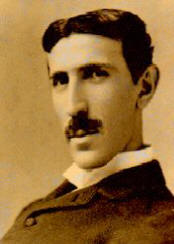
Read all Tesla's Patents (a few sleepless nights)
Tesla began his college education at Graz Polytechnic Institute, pursuing studies of the topic that fascinated him above all others: electricity. Tesla was an extraordinary student who frequently enraged his professors, questioning the technological status quo with an insight that surpassed his instructors. He rebelled most stringently against the acceptance of direct current as the sole means of delivering electrical power. For students exploring advanced academic topics like Tesla's revolutionary work, finding research papers for sale can be useful for diving deeper into complex subjects.
It was plain to him that DC was inefficient and incapable of adequately transmitting power over long distances, and there had to be a better way. There was talk of a theoretical "alternating current" system, but no one had figured out how to make it work. AC was frowned upon as a fanciful dream by the scientific establishment, in much the same way as cold fusion is regarded today. Tesla's merest suggestion of AC brought scorn in his lecture halls, but he was never discouraged enough to abandon the enticing riddle.
Get your own authentic photograph
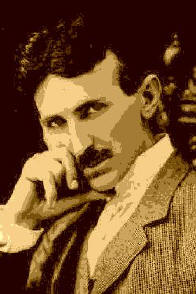 In the middle of Tesla's sophomore year of college, his father was felled
by a stroke. Nikola returned home, and his father died soon after. Tesla never
returned to the Polytechnic Institute. Lacking funds for tuition, he took a
job at a government telegraph office. Tesla despaired for his interrupted education,
but held on to his dream of becoming an electrical pioneer. It was at this time
that Tesla endured his ordeal with hypersensitivity that reduced him to a bedridden
invalid. Considering the depressing turns his life had just taken, the bizarre
affliction could possibly have been psychosomatic in origin. Whatever its cause,
when Tesla finally emerged from the prolonged fugue state, he was armed with
a powerful new insight on how alternating current could be successfully attained.
In the middle of Tesla's sophomore year of college, his father was felled
by a stroke. Nikola returned home, and his father died soon after. Tesla never
returned to the Polytechnic Institute. Lacking funds for tuition, he took a
job at a government telegraph office. Tesla despaired for his interrupted education,
but held on to his dream of becoming an electrical pioneer. It was at this time
that Tesla endured his ordeal with hypersensitivity that reduced him to a bedridden
invalid. Considering the depressing turns his life had just taken, the bizarre
affliction could possibly have been psychosomatic in origin. Whatever its cause,
when Tesla finally emerged from the prolonged fugue state, he was armed with
a powerful new insight on how alternating current could be successfully attained.
Nikola Tesla "Magnifying Transmitter"
His great mental leap was this: two coils positioned at right angles and supplied with alternating current 90 out of phase could make a magnetic field rotate, with no need for the cumbersome commutator used in direct current motors. Tesla knew it would work without even having to build it and test it. Constructing it mentally and letting it run in his mind was proof enough for him. This was Tesla's method for developing inventions throughout his career: no journals, no blueprints, no prototypes.
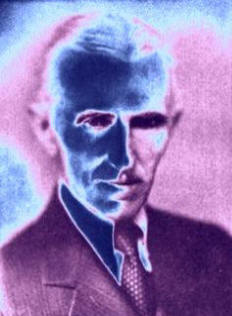
Tesla now possessed the answer, but the problem of putting it into practice remained. In 1882 he found employment with Continental Edison Company in Paris, distinguishing himself as a fine engineer, and, while on assignment to Strassburg in 1883, he constructed, in after-work hours, his first induction motor. In 1884 Tesla was invited to come to America and work for the Edison Company and redesign Edison's machines. Edison made him work from 10:30 am to 5:00 the next morning, seven days a week. Even though Tesla did not believe in Edison's direct current motors he worked hard to improve them.
Edison told him if he could do that he would give him a bonus of $50,000. Tesla worked day and night because the $50,000 would let him set up his own lab and work on his inventions. He came up with twenty-four new designs to replace the old ones of Edison's. Edison was delighted with the results but did not pay Tesla the $50,000 he had promised. When Tesla finally asked him about it, it is said that Edison told him, "Tesla, you don't understand our American humor." That is when Tesla left the Edison Co. and they became rivals. A group of inventors approached him and offered him a chance to form a company of his own: "the Tesla Electric Light Company"
Tesla developed a light that was simpler, more reliable, safe, and economical than what was being used. He patented the lights and they were installed throughout the town. This was a great success, however, all of a sudden the investors took over the company from Tesla. Now, once again, he had no job, no money, and he didn't even own the patents on the things he had developed. He couldn't get an engineering job, so, for a year Tesla worked as a laborer on street gangs, digging ditches and building streets. However, he worked on his inventions during this time and received several more patents. A lot of his inventions didn't really have any use at the time, but became useful years later. For example, he developed a way to transform heat directly into mechanical or electrical energy. This process was "rediscovered" in the 1970's and Tesla was never given credit for it. He said that it was the most depressing time of his life. He even planned on committing suicide on his upcoming thirtieth birthday, at the stroke of midnight.
Before that could happen, A. K. Brown of Western Union Telegraph Company learned of Tesla's plight. Aghast, Brown was determined to restore the genius to a worthy place, and offered to furnish him with a laboratory of his own. And what's more, Brown wanted Tesla to pursue the possibilities of alternating current. Granted a blessed salvation, Tesla immediately went to work assembling his AC dynamo at last. It functioned in reality precisely as it had all those years inside his head.
Tesla demonstrated his invention in a heavily publicized lecture, and instantly became the toast of the engineering community. In 1887 George Westinghouse, who owned most of the electric companies and was a competitor of Edison, went to see Tesla and his alternating current motor. Westinghouse was kind of like Edison in that he was ruthless, but Tesla liked him. Tesla sold his patents to Westinghouse for $60,000 (only $5,000 in cash and 150 shares of stock), and went to work for Westinghouse. He was also supposed to get $2.50 for every horsepower of electricity sold. If that had happened he would have been a billionaire! The transaction precipitated a titanic power struggle between Edison's direct-current systems and the Tesla-Westinghouse alternating-current approach, which eventually won out.
Tesla soon established his own laboratory, where his inventive mind could be given free rein. He experimented with shadowgraphs similar to those that later were to be used by Wilhelm Röntgen when he discovered X-rays in 1895. Tesla's countless experiments included work on a carbon button lamp, on the power of electrical resonance, and on various types of lighting. Tesla gave exhibitions in his laboratory in which he lighted lamps without wires by allowing electricity to flow through his body, to allay fears of alternating current. The Tesla coil, which he invented in 1891, is widely used today in radio and television sets and other electronic equipment. The typical frequency range is from 100 kHz to 1M Hz with typical voltages of several 100kV.) That year also marked the date of Tesla's United States citizenship.
Tesla became known for the lectures at which he demonstrated his inventions and concepts with a theatrical flair. Many attendees were laymen who had little comprehension of what Tesla said, but were mesmerized by the bolts of lightning that leapt from his ominously humming coils, and the unwired light bulbs that lit at the touch of Tesla's hand.
Other pages on Tesla: Article, Biography Part One, Biography Part Two, Patents, Photographs, Statue, Transmitter
Connect with us
Contact us today